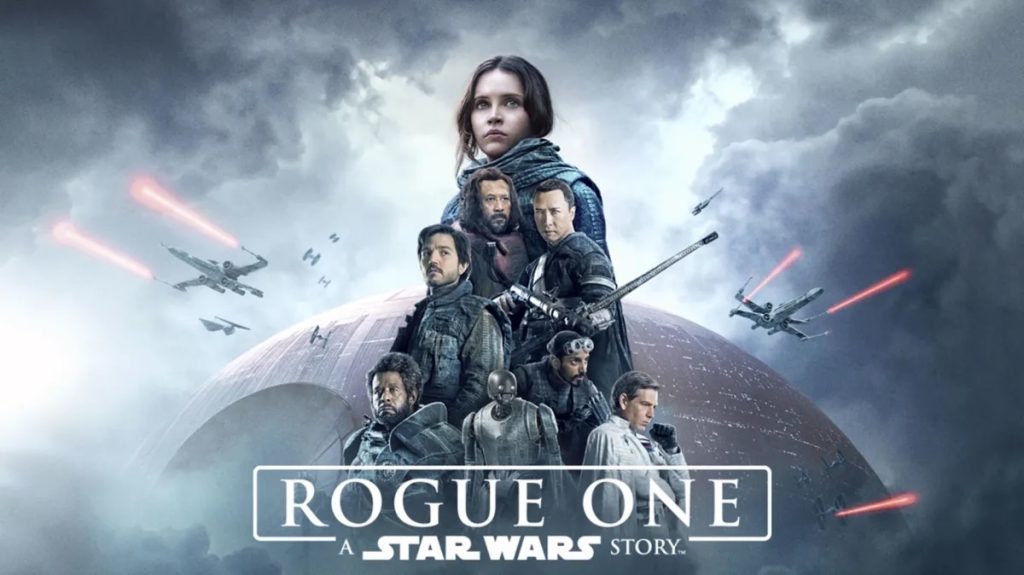
When Disney bought Lucasfilm, there was a lot of concern over whether the company would do the franchise justice. Or at least whether it would do better than George Lucas, whose prequel movies had significantly jaded serious Star Wars fans to the idea that they could expect a worthy successor in their lifetimes.
With last year’s The Force Awakens, Disney showed that it could deliver, if not perfectly then at least competently. Rogue One shows that the feat was not a one-hit wonder.
I saw Rogue One on Thursday at a late-night showing. This is my review. It will contain spoilers — but then, anyone who has seen A New Hope already has seen spoilers. They are right there in the opening crawl.
“It is a period of civil war…”
Rebel spaceships, striking from a hidden base, have won their first victory against the evil Galactic Empire.
During the battle, Rebel spies managed to steal secret plans to the Empire’s ultimate weapon, the DEATH STAR, an armored space station with enough power to destroy an entire planet.
This is essentially the plot of the second half of Rogue One, and as it turns out, director Gareth Edwards and writers Chris Weitz and Tony Gilroy have done a phenomenal job weaving one story into the other. Not only is Rogue One a prequel, but it literally meets A New Hope right where it starts, with the Leia aboard Tantive IV in possession of the stolen Death Star plans and racing away from Vader in his Star Destroyer. It is seamless, in the way a world-class tailor might add a panel of fabric to a suit which has become snug due to corporeal expansion over the last 39 years. Thus, in a way Rogue One has managed to successfully transform (one might say “retcon” if it were possible to do so without pejorative connotations) the context and implications of the original Star Wars movie in a way that has not been done since Vader first declared, “Luke, I am your father.” Given the events of Rogue One, the non-diegetic opening crawl of A New Hope becomes something akin to a “Previously, on Star Wars…” recap, as opposed to a bona fide prologue.
Speaking of crawl text, the first — and for me most jarring — hint (or rather, existential 2×4) that Rogue One is Star-Wars-yet-not-Star-Wars is the missing crawl text. The makers kept the mythological invocation, “A long time ago in a galaxy far, far away…” and the space-planet-starship triad of the opening sequence, but they neglected to insert the open starfield and angled scrolling introduction between them. Honestly, the missing crawl bothered me more than might reasonably expected; it nagged at me repeatedly through the first five to ten minutes of the movie, despite the fact that I’ve already read Catalyst and know the backstory of the Erso family and their relationship with Saw Gerrera.
From a story perspective, the lack of a crawl indicates something else that differentiates Rogue One from other Star Wars movies: This is not part of the Skywalker Saga (i.e., the seven episodic Star Wars films made to date). That may be obvious from the missing episode number, but its ramifications go deeper. In fact, it is not part of a family saga at all, even though one might consider the movie and its setup novel Catalyst to be focused on the Erso family story. Without contradicting what I said above about the seamless connection between Rogue One and *A New Hope, *from a character perspective, this new movie is a standalone story. More importantly, it is explicitly contrasted with the Skywalker Saga in the simple fact that every main character, and almost every minor character, in this movie dies.
Which brings me to the movie’s most distinguishing feature: its darkness.
Darkening the Rebel Alliance
For the most part, dark moments in the Skywalker Saga are relatively rare, and when they do occur, they are mostly perpetrated or facilitated by the bad guys – the Sith, Imperial officers, crime bosses (e.g., Jabba the Hutt), etc. Sure, there are examples of good guys doing some dark stuff, such as Mace Windu telling Anakin that Palpatine needs to die, or Luke giving into his anger and hatred and attempting to kill Palpatine. For the most part, however, those dark moments by good guys are reasonably justifiable. Even some of the more morally questionable moments, such as Han shooting Greedo or Lando betraying his guests, are defensible insofar as they are typically undertaken while under some sort of duress (Greedo already has his gun drawn; Cloud City is under Imperial occupation).
Another way in which the Skywalker Saga is relatively not-dark is the lack of (main character) good guy deaths. The original trilogy has Obi-Wan, but otherwise no significant good guys die – except Yoda, whose natural death after 900+ years can hardly be considered “dark.” (Okay, and Anakin, but he’s a good guy for a only a brief period at the end of Return of the Jedi, and his death is more redemptive than dark.) More high-profile good guys die in the prequel films (Qui-Gon, Mace Windu, Padme), and of course Episode VII sees Han’s death at the hands of his son. Nonetheless, these are again exceptions for the most part. Even notable minor character deaths — Owen and Beru Lars, Shmi Skywalker/Lars, the various Jedi who die in the prequels, and even the “many Bothans” who secure the second Death Star plans — are but moments of passing darkness in otherwise adventurous, heroic, and uplifting stories.
Rogue One flips the ratio. From early on in the movie, it is clear that we are dealing not with the whitewashed action of the Skywalker Saga, but something darker and more heavily stained. It starts with Jyn Erso’s mother Lyra and her willingness to kill to protect her family, rather than run away; even Orson Krennic, who knows the Ersos pretty well as shown on the book Catalyst, is surprised when Lyra shoots him in the shoulder before immediately being killed herself. Lyra’s death and the capture of Galen leave Jyn to be raised by Saw Gerrera, an anti-Empire radical whose guerilla methods are too extreme for the Rebel Alliance – a fact illustrated later when we see Saw’s band of extremists engaging in a style of urban assault that seems far too similar to something one might witness in, say, the current Syrian civil war. But even as Mon Mothma and her merry band of Rebels are denouncing Saw’s methods, they are simultaneously relying on individuals like Cassian Andor, whose introduction shows him killing a fellow Rebel (or at least an Alliance-friendly independent) who is too injured to flee from incoming stormtroopers: To be sure, Andor does not kill the man out of mercy, but rather to make sure that he cannot betray the Rebellion’s secrets to Imperial torturers. Other examples abound, from Saw’s torture of defector pilot Bodhi Rook to General Draven’s order to assassinate Galen Erso.
The darkness of Rogue One is not limited to just the actions of the main characters, but also to the number of deaths that occur among them. It is one thing to have Lyra die early – this is not the first Star Wars movie to feature a child removed from its parents – but as the story progresses, we also see Jyn’s other parental figures, Saw and Galen, both die. However, it’s not until K-2SO gets shot, and then shot again, and then shot again, and finally seals Jyn and Andor off from himself and the stormtroopers gunning him down that the realization comes: They are not all going to make it out alive. Even then, though, it took time for it to dawn on me that none of the crew of the Rogue One were going to make it. And not only do all of the main characters die, but they do so in grittier ways: Bodhi gets blown up in his ship; Chirrut is killed when blaster fire hits a nearby…something…and it explodes; Baze is shot multiple times before being blown up by the dropped grenade of a dead Death Trooper; Andor miraculously recovers from falling down the archive shaft, only to die on the beach of Scarif embracing Jyn as a blast from the newly minted Death Star overtakes them. These are no lightsaber-through-empty-robe deaths; the Battle of Scarif is the Star Wars universe equivalent of Saving Private Ryan’s Omaha Beach landing.
Not only are the main character deaths dark and numerous, but the wantonness of tangential deaths is greater as well. Ponder this: The Death Star is used on twice as many planets in Rogue One as BOTH Death Stars are used in the original trilogy. (Granted, it is not used at full power, so does not destroy the planets, but nonetheless – wantonness!) Likewise, in the original trilogy, we see Vader kill a total of 11 people: Obi-Wan (lightsaber), Palpatine (shafted), two Imperial officers (Force-choked), and the rest are Rebel pilots he shoots down during the trench run in A New Hope; however, in Rogue One we see him slicing through Rebel soldiers like they’re battle droids from the CGI Clone Wars series. Granted, in the prequel movies we see Anakin killing people (and like the Doctor, by “people” I mean aliens) left and right, including a roomful of Jedi younglings (okay, we don’t actually see him kill the younglings) – but somehow the deliberate nature of his striding through the Rebel ship, pursuing the stolen plans as they are passed from one soon-to-be-butchered Rebel soldier to another, just feels more nefarious and personal.
On the Scarif beachfront, not only did the Rogue One crew all die, but so did all of the soldiers who landed with them, plus the reinforcements that are able to slip through the planetary shield gate before it closes. In the space battle, fighters make near-kamikaze runs to bomb Scarif’s planetary shield, while Admiral Raddus urges the entire fleet to press harder. Once the Death Star plans are beamed up to the ship, as the Rebels begin to retreat victoriously, some of their ships smash spectacularly into Darth Vader’s Star Destroyer as it emerges from hyperspace, dooming the vast majority of the remaining Rebel fleet to utter destruction. For an example that doesn’t occur in the climactic battle, during the guerrilla attack in Jedha, Andor shoots a grenadier – a member of Saw’s band and ostensibly an ally of the Rebellion – in order to save Jyn, and watches as the grenadier fall into a street-level market stall and kill an unknown number of people (either innocent bystanders or more guerrillas, it’s not entirely clear in the heat of things). Granted those people would have died anyway when the Death Star obliterated the city, but again it’s the willingness to show a dark and messy side of the Rebellion that distinguishes this movie from other Star Wars films.
Note that I said “films.” Such darkness is not unheard of in other Star Wars media, especially if you include the Legends (née Expanded Universe) stories. In effect, Rogue One isn’t so much a deviation from existing Star Wars stories as an alignment of cinema with other stories that have explored some of these darker avenues. Even canonical stories, such as some episodes/arcs in Clone Wars and Rebels, have examined darker themes and actions, if not quite in the same way that Rogue One does. Which is one of the great advantages of standalone stories like Rogue One.
“Rebellions Are Built On Hope”
Despite the willingness to explore the darker side of the rebellion, the clear theme of the movie is one of hope. If the refrain “Rebellions are built on hope,” first uttered by Cassian and then repeated by Jyn during her impassioned speech before the Rebel council, does not solidify this idea, then Leia’s delivery of it as the last word of the movie undoubtedly drives it home (especially considering the title of Episode IV: A New Hope).
The irony is that hope is not enough on its own. One cannot merely hope that the world (or galaxy) will be made better; one must channel that hope into action and trust that the act will bear fruit for others. Some have described A New Hope as a movie of coincidences; Rogue One is pointedly a movie of choices, good and bad. As Jyn tells the soldiers before Rogue One lands (paraphrased), you have to take one chance, then the next, and then the next, until there are no more chances to take. This sentiment is played out not only during the incursion on Scarif Galen, but throughout the movie as well. There is a clear chain of decisions based on hope and trust that drive the story forward:
- Galen’s trust in Bodhi to deliver his message to Saw, and Bodhi’s trust that the message will redeem him
- Jyn’s trust in her father’s inherent goodness and competence (notice how she never even doubts that her father was able to actually install a secret defect)
- Cassian’s eventual trust in Jyn as a capable leader, and his ability to inspire that same trust in the other spies and assassins who join them
- Chirrut’s trust in the Force, and Baze’s trust in Chirrut, which lead them both to join up with Jyn and team
- The trust of Admiral Raddus and others that the crew of Rogue One will accomplish their mission, with a little help
Thus, the plot of Rogue One becomes a chain of active hope, in which each link requires the individual to believe that their action in that moment will improve the world in some way – perhaps not immediately, but ultimately. This is qualitatively different from reactive desperation (even though some of the actions are certainly desperate), in which an individual is simply responding to stimuli and emotions. The actions of the *Rogue One *crew, indeed all of the Rebels, are purposeful. They are in pursuit of a positive, principled goal, not merely defending an attack or resisting an affront.
This theme of active hope in Rogue One offers us a remarkable new way to understand A New Hope, and to reassess the perceived coincidences of that original film. R2 and 3PO did not just happen to land on Tatooine because Vader caught up with the Tantive IV above that planet – it was Leia’s destination all along. In Rogue One, we see the brief conversation between Mon Mothma and Bail Organa, in which Bail hints that his adoptive daughter is the one chosen (or the Chosen One…) to take possession of the Death Star plans and deliver them to Obi-Wan Kenobi. The implications of this are enormous, given that not only is Bail the only person alive (besides Yoda) to know where Kenobi is, but he also knows that Kenobi is watching over Luke. Is hoping that by sending Leia to Tatooine to deliver the Death Star plans to Kenobi he will also facilitate a meeting between the siblings? We don’t get an explicit answer, but it is hard for me to believe that Bail, who is always shown to be intelligent, insightful and strategic, did not consider the broader implications of the mission he gives Leia.
Ultimately, the explicitly hopeful themes of the movie coupled with the darkness of its tone and the deaths of its characters make for an interesting story with complex and unexpected developments. In this respect, it is everything a prequel should be.
Is Rogue One a “Standalone” Movie?
Rogue One is the first of Disney’s planned standalone (or “anthology”) movies, contrasted with the episodic films that I’ve been referring to as the Skywalker Saga. The fact that I have had to employ a new term to distinguish the episodic films from Rogue One could be construed as an indication of its independence from those films. Likewise, Rogue One is standalone in the sense that everybody dies: We are never going to see Jyn, Cassian, Chirrut, Baze, Rook, K2, Saw, Galen or Lyra again. Their stories are over; they are part of the Cosmic Force now, and they will not appear in future stories (though, I’m holding out hope for a Chirrut and Baze backstory novel!). Despite these acknowledgements, however, the more I think about it, the less I consider Rogue One to be a “standalone” story in the ordinary sense of the word. In various reviews I’ve seen the film referred to as a prequel, Episode 3.9, “connective tissue,” and similar terms that imply I’m not the only one to question its standalone status.
As I stated above, Rogue One weaves seamlessly into the beginning of A New Hope. Leia, in possession of the Death Star plans, is the last person to speak in the film, and I imagine very little time passes between the end of one story and the beginning of the next: certainly less time than between any two of the Skywalker Saga movies. Furthermore, Rogue One makes little-to-no sense without those other films, especially A New Hope, which fulfills the heroism of the Rogue One crew and imbues their sacrifices (collectively and individually) with meaning. It also resolves what has historically been considered a plot hole in A New Hope, the existence of an engineering flaw by which the the Rebels can destroy the Death Star. Even smaller moments – references to places (Yavin IV), character cameos (Mon Mothma, Bail Organa, Leia, R2-D2 and C-3PO), certain lines (Rebel squadron leader role call, “I have a bad feeling about this”), and visual cues (vaporators and blue milk in the Ersos’ farmstead, a Mon Cala strikeforce leader) – are much more palpable within the context of the Skywalker Saga films than they would be without that context.
Looking again at the larger canonical picture, Rogue One is even less of a standalone story. Of course there is Catalyst, which focuses on the scientific, technological, and political background of the Death Star’s construction. Tarkin (written by Catalyst author James Luceno) is likewise something of a prequel to Rogue One, insofar as it tells Grand Moff Tarkin’s story up to the point where Vader assigns him to oversee the Death Star’s construction. There are even implications for stories like Lost Stars, which is where the first mention of Krennic occurs in passing. Far from being a standalone story, Rogue One neatly fills a gap in the narrative development of that galaxy far, far away.
So while I can appreciate the desire to identify Rogue One as something different than the films that have preceded it, I don’t think “standalone” is the right word to describe it. Perhaps future anthology stories, such as the forthcoming Han Solo character study, will better fit the standalone designation, but Rogue One certainly does not match it. Neither is Rogue One a spinoff, as I have seen some advance articles and reviews describe it. A spinoff takes characters, usually secondary or minor, from one story and provides a venue in which to develop their own stories – such as Angel (from Buffy the Vampire Slayer) or Marvel’s Agents of S.H.I.E.L.D. and Agent Carter – without overlapping (mostly) the original storyline. Rogue One does not spin characters off into a separate story, but instead cleanly grafts an entirely new chapter to the trunk of the primary storyline.