Skip to content
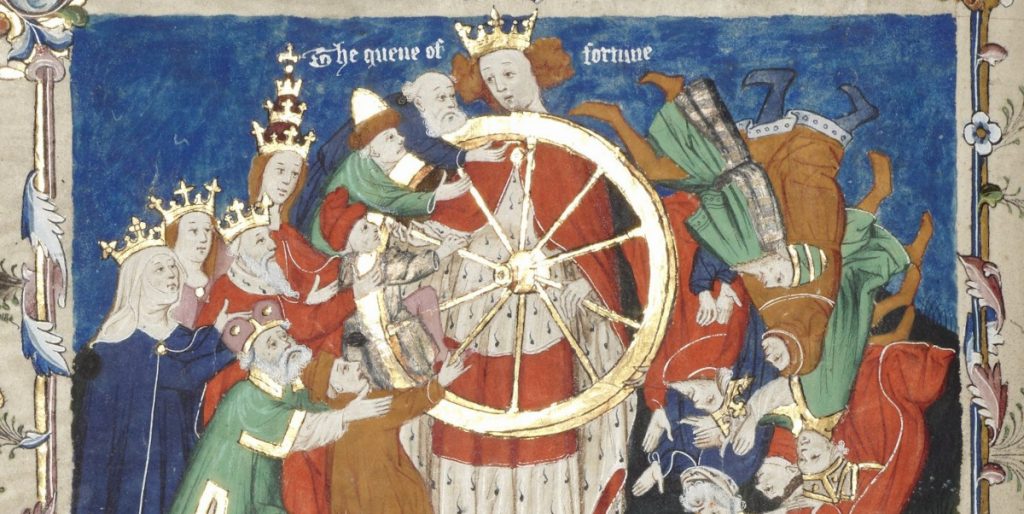
This past Tuesday I started reading “The Consolation of Philosophy” by Boethius. (In English translation—it’s been a long time since I studied Latin.) In hindsight, that may have been a mistake.
For those who haven’t read it, my very reductionist summary is this: Boethius, in exile and about to be executed, gaslights himself into believing that being on death row is actually a GOOD thing, because ill-fortune gives us more growth opportunity than good-fortune.
This moral is hard for me to swallow.
“They Did You a Favor”
In “Consolation,” the personification of Philosophy says of Boethius’s imprisonment and impending death:
My opinion in fact is that adverse Fortune benefits people more than good, for whereas good Fortune seems to fawn on us, she invariably deceives us with the appearance of happiness, [while] adverse Fortune is always truthful and shows by her mutability that she is inconstant. The first deceives, the second instructs…
The upshot of this, Philosophy continues, is that during times of good fortune we tend to let our eyes wander away from the things that truly make us happy, while times of ill fortune tend to help us recalibrate our priorities.
We see a lot of similar sentiment in modern sayings like:
- What doesn’t kill you makes you stronger
- When one door shuts, another opens
- Obstacles are just stepping stones to success
There’s plenty of other phrases like this. Another one that tends to crop up due to unexpected events is: “Actually, they actually did you a favor.”
Platitudes like these tend to bug me, even when they were written 1400 years ago in another language. Yes, growth and strength and long-term positive outcomes can come out of hardship. But it’s certainly not a given, and there are a lot of times where recovery is not possible.
When I was a teenager, I tore my ACL. Doctors repaired it with part of another ligament from the front of my leg. I was fairly active when I was younger, playing soccer and basketball and water polo. I know a lot of people who’ve come back from such surgeries and been able to recapture at least some of their former athleticism. I never have.
All this to say that while it’s possible for some people to recover and even thrive after adversity, that’s certainly not a sure thing. It’s difficult to read that logic when there’s fresh frustration and new anxiety to deal with.
Boethius Had it Way Worse Than Me
And yet…my situation is not nearly as dire as Boethius’s was.
Sure, losing a job is tough. Finding a new one will be tough, too, but at least I have the opportunity to do so. Boethius wrote his treatise knowing he was never going to make it out of exile alive. And sure enough, he was killed shortly after he finished writing it.
Which is to say that my objections and complaints sound a little hollow even in my own ears. I don’t have any emperors angry with me. I don’t have any imminent doom hanging over me. My life expectancy is as good as any other person of my demographic and medical history.
Part of me—most of me, even—does believe that I’ll find something good out of this. I’ve been in a similar situation before, and I came out of it with a good job. I learned a lot over the last ten years, and gained a lot of valuable skills and experience. On top of that, I have connections and friends I didn’t have the last time around, and I even know a thing or two about marketing now.
Maybe I’m just channeling my inner Boethius and gaslighting myself, now. If that’s what it takes to move on, so be it.